



See Your Future More Clearly with Valeda
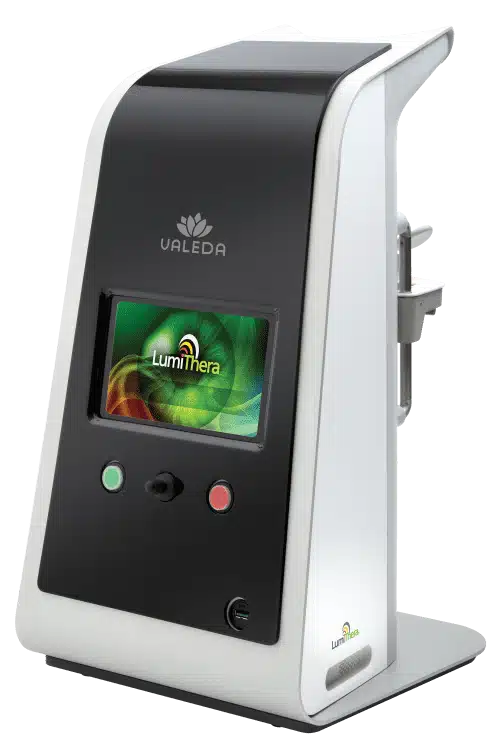
Valeda delivers the first FDA-authorized treatment for dry AMD with non-invasive, clinically proven light therapy that can offer real hope.
Do you have dry macular degeneration?
If you’ve been diagnosed with dry age-related macular degeneration (AMD), there may be new hope for preserving and potentially improving your vision. Valeda is the first and only FDA-authorized light therapy system that may be able to help patients with dry AMD see more clearly now and in the future.
Using gentle, non-invasive photobiomodulation therapy, Valeda can help stimulate cellular health in your retina with specific wavelengths of light. Through a series of brief treatment sessions over 3-5 weeks, patients may experience potential improvements in their vision. Treatment series are typically repeated every 4 months to help maintain results.
No drugs, no needles, no discomfort – just advanced light therapy that can be a part of a treatment plan to help you preserve your vision!
How Does Valeda Photobiomodulation (PBM) Therapy Work?
As those with dry AMD age, the retinal cells start to weaken and lose their ability to function properly. This leads to the buildup of deposits called drusen and affects the ability to see clearly.
Valeda uses photobiomodulation (PBM) therapy, which is a specific type of light treatment that delivers carefully calibrated wavelengths of light directly to your retina. This can help stimulate energy production within your retinal cells, supporting their natural functions.
For the right patient, the treatment may help restore weakened cells and support their ability to maintain good vision.
Treatment Schedule
9 Total Treatments over 4-5 Weeks
Treatments last 10-15 mins
Protect your sight — early detection makes all the difference
The earlier AMD is diagnosed and monitored by an eye care professional, the better the results will be in treating the disease and preserving your vision.
Here at Tucson Eye associates we can determine how frequently you need to be seen for checkups and treatments based on your unique vision health and family history.
Age-Related Macular Degeneration (AMD) is a progressive disease that happens in 3 stages:

Early
Small waste deposits, called drusen, form in the back of the eye. People with early AMD typically do not experience vision loss.

Intermediate
Deposits increase in the number and/or size. They may cause some vision loss, but some people will not have obvious symptoms.

Advanced
In addition to drusen, vision loss can occur from excess fluid and blood (wet AMD) and/or death of retina cells (GA).
Symptoms Include

Straight lines appearing wavy

Harder to see at night

Blank spots obscuring central vision
Words are blurry, and colors are washed out
Benefits of Valeda
Valeda is the first and only FDA-authorized treatment for dry AMD that has been studied for its potential to support clearer vision. For the right patient, Valeda may help protect vision and support clearer sight over time. When studied, Valeda showed results such as:
Potential for Improved Visual Acuity:
In clinical studies, patients who received Valeda treatment were able to read one additional line on the eye chart on average after two years compared to those who didn’t receive treatment.
Ongoing Benefits:
Research suggests that with repeated treatment series, patients may experience continued potential benefits over extended periods.
Improved Retinal Health:
Retinal imaging may show improvement in eye scans when assessed for drusen (protein deposits observed in eyes with dry AMD).
Who is suitable for the VALEDA treatment?
VALEDA is indicated for use in the treatment of dry age-related macular degeneration (AMD) patients with vision impairment. Those individuals receiving treatment should have a doctor diagnosis of Dry AMD. The stage of Dry AMD may impact the benefits of the treatment. Your doctor will discuss your diagnosis and treatment plan with you.
What can I expect during and after the VALEDA treatment?
It is well known that looking at bright light can produce an afterimage. Another name for this is photobleaching, where the cells that “see” that specific color become fatigued.
For example, if you look at a red light, those colors may fade after treatment and you will see more of the opposite color (i.e., green). This phenomenon may be seen immediately following the treatment and will recover in a couple of minutes.
You will be able to partake in normal activities following the treatment.
What’s involved with the VALEDA treatment? Do I need any special preparation?
If you wear glasses or contact lenses, you will be asked to remove them prior to receiving treatment. Your eyes will not be dilated for the VALEDA treatment. You will be seated comfortably at the VALEDA Light Delivery System.
The person administering the treatment will guide you through each step of the treatment which takes less than 5 minutes. Treatment for both eyes will take less than 10 minutes. Clinical trials have shown benefits in visual function following treatment 3 times a week for 3-4 weeks. This is the recommended treatment protocol for patients with Dry AMD.
In a recent clinical study, patients received no more than 3 treatments a week and no more than one treatment in a 24 hour period. If you miss a treatment, it is recommended to make up the session within the 3-4 week treatment series period.